
By Kanji Usui
Pareto's Principle in Action
Do you know about "Pareto's Principle"?
It's an empirical rule stating that "80% of overall results are generated by 20% of the elements"—for example, 20% of employees generate 80% of sales.
The other day, I attended a general assembly-type business networking event where I encountered people saying things like "We made ○○ hundred million yen in sales!!!" with very aggressive energy. It got me wondering: what percentage of people actually make up what proportion of the results?
Since the networking organization publicly shares at least some of their data, I decided to run the numbers.
The result was... (skipping the calculation process)
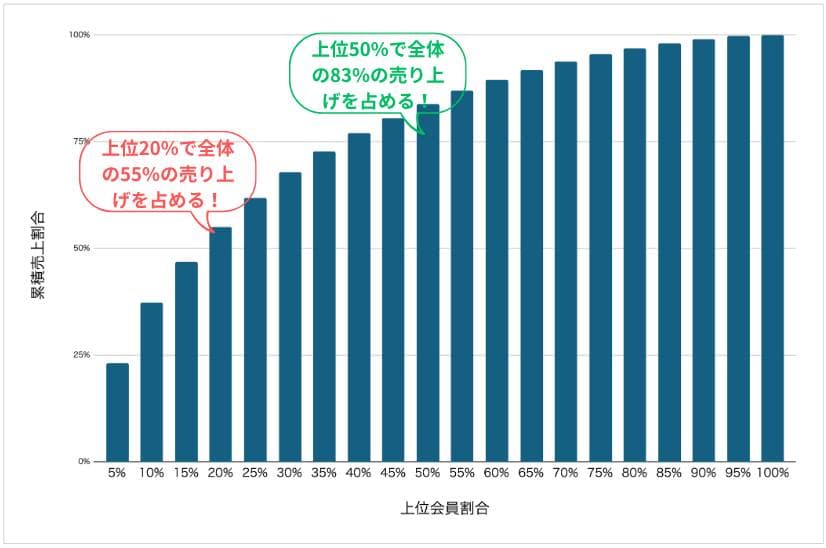
"The top 20% account for 55% of total sales"
※ This is an estimate, as the data is incomplete
While technically it's not exactly "sales," it felt intuitively about right to me.
Incidentally, the top 50% accounts for 83% of total sales.
Just for fun, I also calculated the per-person figures:
※ These are estimates only. Since we don't have annual data, these are reference values assuming approximately 2 years of activity.
- Top 1% (elite tier): 46 million yen
- Top 5% (elite tier): 30.8 million yen
- Median (most common): 3.9 million yen
Making things "visible" through concrete numbers—not just intuition—really matters.
I'll keep pushing forward...